Ready to Start you Retail Chain?
Become Top Products Retailer
Get Brand Tools, Machinery, Accessories and Equipment and Start your Retail Business

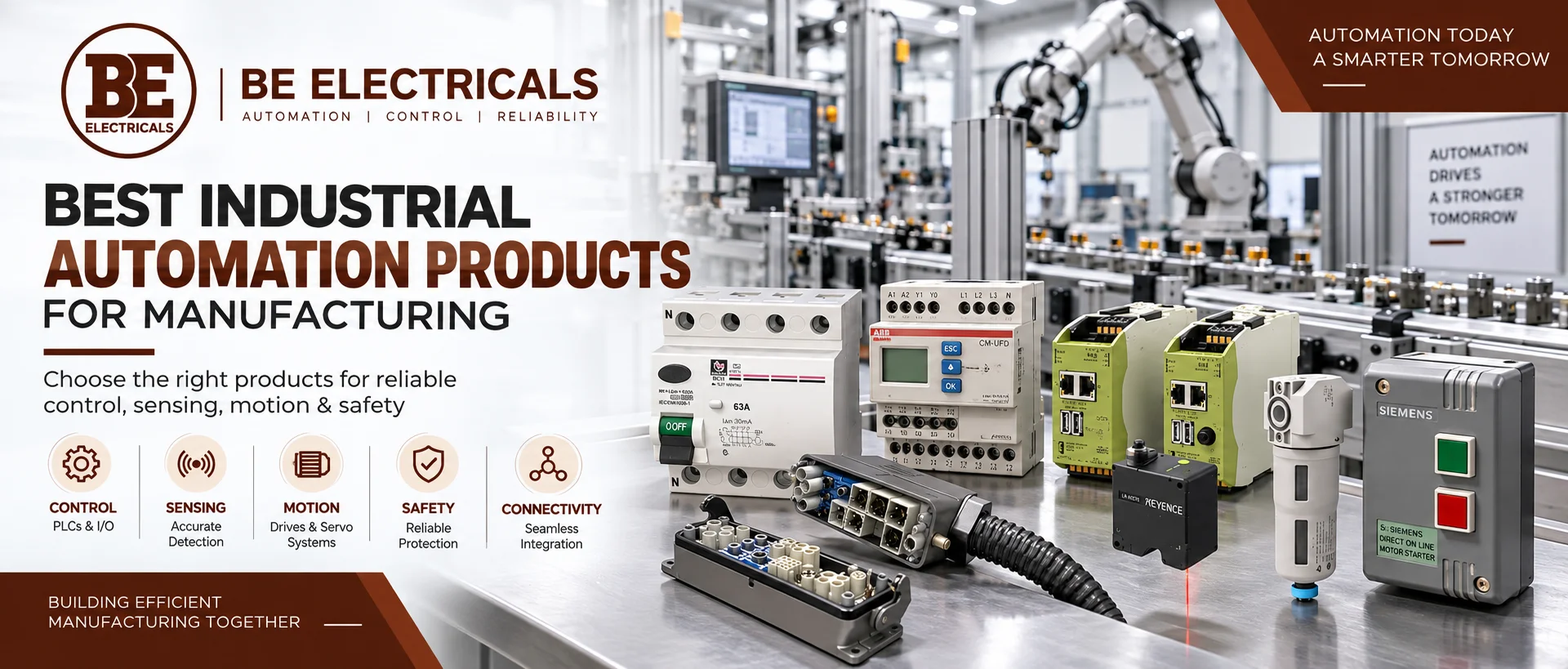
A production line can have a capable controller, a well-built conveyor and an experienced operator—and still stop because a sensor misses a part.
That is why buying industrial automation products takes more than comparing catalogue specifications. Each product needs to suit the job, communicate with the existing system and remain practical to maintain when production is under pressure.
For a procurement manager, the question is usually straightforward: which equipment will solve the problem without creating another one?
This guide compares the main product categories used in manufacturing, explains where they fit and highlights the checks worth making before requesting a quotation. It also shows how buyers can use BE Electricals’ automation and electrical product ranges to prepare a practical shortlist.
The best industrial automation products depend on the production task: PLCs manage machine sequences, sensors detect process conditions, VFDs control motor speed, and servo systems handle precise movement. HMIs, machine vision, safety devices and industrial communication equipment support operation, inspection and integration.
The comparison below is a starting point for shortlisting product categories, rather than a ranking of individual brands or models.
Product category |
Best suited to |
Main buying consideration |
|---|---|---|
|
PLCs and I/O modules |
Machine sequencing and coordinated control |
I/O requirements, processing needs and compatibility |
|
Industrial sensors |
Part detection and process measurement |
Target material, environment and response time |
|
HMIs |
Operator control, alarms and recipe selection |
Usability and controller communication |
|
Variable frequency drives |
Adjustable motor speed |
Motor current, load duty and operating conditions |
|
Servo motors and drives |
Accurate positioning and coordinated motion |
Torque, inertia, speed and feedback |
|
Pneumatic components |
Repetitive clamping, pushing and gripping |
Force, stroke, cycle rate and air quality |
|
Machine vision systems |
Visual inspection and code reading |
Defect criteria, lighting and line speed |
|
Machine safety components |
Safety functions around hazardous machinery |
Risk assessment and validated system design |
|
Industrial communication equipment |
Connecting controllers and field devices |
Protocols, topology and diagnostics |
|
Condition monitoring devices |
Tracking changes in equipment health |
Useful measurements and maintenance response |
Industrial automation products are devices and supporting systems that detect conditions, process information and control manufacturing operations. They include controllers, sensors, drives, operator interfaces, actuators and communication hardware.
These products work together. On a filling line, for example, a sensor detects a container, a controller checks the sequence, and an actuator operates the filling mechanism. An HMI displays the machine status and allows authorised adjustments.
The terms industrial automation equipment, factory automation products and industrial automation components often overlap. For purchasing, the useful distinction is the scope of supply: an individual device, a configured assembly or a complete installed system.
A quotation should make that distinction clear.
A programmable logic controller, or PLC, executes the control logic that coordinates a machine. Input/output modules connect it to devices such as sensors, switches, valves and drives.
PLCs are relevant when a process needs repeatable sequencing: a conveyor stops at a station, a clamp closes, an operation completes, and the part moves forward.
Before selecting a controller, establish the number and type of signals required. Digital inputs, analogue measurements, high-speed counting and motion functions place different demands on the system.
Also check the programming software, communication interfaces, expansion options and availability of project backups.
Buyer takeaway: Choose a PLC platform your maintenance team or integration partner can support. A lower hardware price may be outweighed by unfamiliar software and longer troubleshooting time.
For a starting shortlist, explore BE Electricals’ Siemens automation products, which include PLC controllers. Confirm the exact CPU, I/O modules and software requirements for your machine.
Sensors give the control system information about what is happening on the machine. Depending on the technology, they can detect objects or measure position, pressure and other process conditions. Balluff’s sensor portfolio illustrates this range, including inductive, photoelectric, capacitive, ultrasonic and position-sensing products.
Selection starts with the application. What must be detected? At what distance? How quickly? Will the sensor face oil, dust, vibration, washdown or changing ambient light?
For example, metal-part detection and transparent-container detection present different challenges. A sensor that works reliably in one application may be unsuitable for the other.
Check the sensing principle, output type, supply voltage, connector arrangement and mounting space. Where detection is difficult, request a trial using actual production samples.
Buyer takeaway: Match the sensor to the target and environment before comparing price.
BE Electricals’ Carlo Gavazzi automation range includes proximity and photoelectric sensors. Compare the actual sensing principle and output specification before requesting an equivalent replacement.
A human-machine interface, or HMI, gives operators a way to view machine conditions and interact with the control system.
It can display production counts, settings, alarms and operating instructions. Its value depends heavily on how those screens are designed.
An alarm that says “Fault 27” leaves the operator searching. A message that identifies the affected station and the required check can make troubleshooting more direct.
Compare controller compatibility, display visibility, touch operation, user permissions and recipe requirements. Ask whether screen development, software licences and editable project files are included.
Buyer takeaway: Evaluate the operator’s daily tasks, not just the screen size.
Variable frequency drives, or VFDs, adjust the electrical supply to an AC motor so its speed can match the process requirement. They are commonly considered for pumps, fans, conveyors and other motor-driven equipment. ABB explains how drives regulate motor speed and torque to suit demand.
Potential energy savings depend on the application and operating profile. Installing a drive does not automatically produce the same savings on every machine.
For selection, review motor nameplate current, supply voltage, load characteristics, overload duty and ambient conditions. Consider braking requirements, cable length and the motor’s suitability for drive operation.
Buyer takeaway: Compare the complete motor-and-load requirement. A matching kilowatt rating alone is not enough.
Buyers evaluating motor speed control can review the ABB drives range at BE Electricals and submit the motor nameplate details, application and required operating speed with their enquiry.
Servo systems are worth considering when a machine needs controlled positioning, rapid indexing or coordinated movement between axes.
Typical applications include cutting, labelling, assembly and pick-and-place equipment. The useful question is how accurately and quickly the load must move throughout the operating cycle.
Selection involves torque, speed, load inertia, acceleration and mechanical transmission. The motor, drive, feedback device and controller must form a compatible system.
A larger motor is not automatically a better solution. Incorrect sizing can increase cost while leaving the underlying mechanical or control problem unresolved.
Buyer takeaway: Share the motion profile and load details with the person sizing the system.
Pneumatic cylinders, valves, grippers and air-preparation units are used for tasks such as clamping, pushing, sorting and gripping.
They can be practical where the required movement is straightforward and suitable compressed air is available. Their performance still depends on correct sizing and installation.
Check the required force, stroke, cycle frequency, operating pressure and valve flow capacity. Include tubing, fittings and mounting accessories in the quotation.
Running costs also matter. Air leakage, pressure losses and poor air quality can undermine an otherwise workable arrangement.
Buyer takeaway: Compare pneumatic and electric actuation where variable positioning or compressed-air costs are significant.
The Festo pneumatic products range provides a relevant starting point for enquiries about cylinders and associated motion components. Specify the complete assembly and accessories required.
Machine vision systems use cameras, lighting and processing tools to inspect products or read identifiers.
Potential tasks include checking component presence, label position, assembly orientation and printed codes. However, “detect defects” is not a sufficiently detailed specification.
Define the smallest unacceptable defect, product variation, inspection speed and acceptable false-reject rate. Test representative good and defective samples under realistic conditions.
Lighting deserves particular attention. Reflections, shadows and inconsistent presentation can make a camera’s job difficult regardless of its resolution.
Buyer takeaway: Request a documented application trial and agreed acceptance criteria before approving a production system.
BE Electricals lists Keyence automation products, including vision systems. Confirm the camera, lighting, software and integration scope for the proposed inspection task.
Safety relays, safety controllers, interlock switches and light curtains can form part of a machine’s protective system.
Selection must follow the machine’s risk assessment and required safety functions. The assessment determines what protection is needed; the components must then be integrated and validated accordingly.
A standard sensor or ordinary PLC should not be assumed suitable for a safety function simply because it can detect a condition or stop a cycle.
Include stopping behaviour, reset arrangements, fault response and operating access in the engineering review.
Buyer takeaway: Purchase a defined and validated safety solution, with clear responsibility for its design and testing.
The Pilz safety product range is relevant when sourcing safety relays or controllers. Component supply and validation of the complete safety function should have clearly assigned responsibilities.
Industrial switches, remote I/O, gateways, communication masters and connectors allow automation devices to exchange information.
These products become especially relevant when expanding a line or connecting equipment from different manufacturers.
Check the exact protocols, device roles, supported functions and configuration requirements. Two devices having Ethernet ports does not establish that they can exchange the required production data.
Also review cable routing, network diagnostics, access control and responsibility for configuration backups.
Buyer takeaway: Confirm interoperability at the application level before ordering the hardware.
Condition monitoring devices track measurements such as vibration or temperature so maintenance teams can identify changes that deserve investigation.
They are most useful when applied to an asset with a clear failure concern and a team ready to act on the information.
Before purchasing, decide what will be measured, where the device will be mounted and how readings will be interpreted. Establish a baseline and identify who reviews alerts.
Collecting data does not, by itself, predict every failure or prevent downtime.
Buyer takeaway: Start with a defined maintenance problem and a small pilot before extending monitoring across the plant.
A controller and its field devices depend on reliable power, sound connections and suitable circuit protection. These supporting industrial automation components deserve a place in the purchase specification from the beginning.
Contactors, overload relays, circuit breakers and motor starters perform different switching and protection tasks. Select them around the load, duty and electrical design rather than treating similarly rated devices as interchangeable.
BE Electricals’ Bhartia BCH switchgear range includes products relevant to motor-control applications. Ask the panel designer to confirm the device combination, coil voltage and protection coordination before ordering.
A mismatched insert, missing hood or unsuitable cable gland can hold up an otherwise complete installation. For a connector assembly, verify the mating parts, contact arrangement, electrical ratings, cable entry and environmental suitability.
The Harting industrial connectors range is relevant when planning machine connections. Quote complete assemblies and required accessories so that both ends of the connection are covered.
Energy meters can help identify consumption patterns when the measurement points and reporting purpose are clear. Monitoring relays can provide signals or protection functions for specified electrical conditions, depending on the selected model and circuit.
For these requirements, BE Electricals lists energy meters, monitoring relays and solid-state relays within its Carlo Gavazzi range. Confirm measurement configuration, output and communication requirements; a device that displays a value locally may not provide the data interface your system needs.
Include these supporting products in the bill of materials alongside the PLC, sensors and drives. It is easier to check compatibility before procurement than to resolve missing components during installation.
Write down the issue in measurable terms.
“Improve efficiency” is too broad. “Reduce missed-part detection at the transfer station” gives the supplier a problem to evaluate.
Useful starting measures include downtime minutes, rejected units, changeover time, cycle time and energy consumption per unit. Choose the measure that directly relates to the proposed investment.
Before approving a replacement or upgrade, compare:
A product described as an “equivalent” still needs a documented technical comparison. Similar appearance or matching headline specifications do not establish interchangeability.
Ask how the equipment will be restored after a failure.
Can the plant obtain a replacement quickly? Are parameter files available? Does the maintenance team have the necessary software? Is the product approaching discontinuation?
These questions matter particularly for imported components or equipment installed at several sites.
Standardising selected industrial automation components can simplify spares and training, provided the chosen products remain suitable for each application.
There is no useful single price range for industrial automation products as a whole. A proximity sensor, a PLC panel and a complete inspection station have very different scopes.
Compare quotations using the total installed cost, then consider the expected operating and support costs.
Cost area |
What the quotation should clarify |
|---|---|
|
Hardware |
Exact models, quantities and accessories |
|
Engineering |
Design, programming and integration scope |
|
Software |
Development tools, runtime licences and renewals |
|
Installation |
Wiring, mounting, panel work and site requirements |
|
Commissioning |
Testing, production trials and acceptance criteria |
|
Training |
Operator and maintenance handover |
|
Support |
Warranty route, response scope and service charges |
|
Spares |
Recommended parts and confirmed availability |
For illustration, suppose an upgrade costs ₹3,00,000 installed and is expected to deliver ₹25,000 in net monthly benefit. Its simple payback would be 12 months.
That is a calculation example, not a market quotation or guaranteed return. Use measured production data, allow for recurring costs and avoid counting the same benefit twice.
A useful quotation answers technical and commercial questions together.
Ask the supplier to confirm the exact manufacturer and part number, supply condition, lead time, warranty terms and included accessories. Where authorised distribution is claimed, request evidence that can be checked with the manufacturer.
For substitutions, ask for a written comparison covering electrical, mechanical, communication and functional differences.
Also establish who is responsible for programming, installation and commissioning. Product supply and system integration may be separate services.
For projects in India, confirm the delivery location, freight, applicable taxes, local support arrangements and replacement process. A competitive unit price is less helpful if a missing connector delays installation.
BE Electricals supplies industrial automation and electrical products for manufacturing, panel-building and maintenance requirements. Its brand directory covers controllers, sensing, drives, safety, pneumatics and connection technology.
For a new project, send a bill of materials with the required brands, part numbers and quantities. For a replacement, include the existing model, relevant datasheet and the operating problem. Ask for any proposed substitution to be identified separately so your engineering team can approve it.
BE Electricals accepts enquiries for both small quantities and bulk orders, with supply across India. Confirm availability, delivery dates, warranty terms and documentation against the exact products quoted. A brand listing is a useful starting point; the confirmed quotation should establish the scope of your order.
For projects that require programming, panel work or commissioning, agree those responsibilities explicitly with the supplier and integration team. A clear scope helps procurement compare the full requirement and plan the installation.
Common categories include PLCs, I/O modules, sensors, HMIs, motor drives, actuators, safety devices and communication equipment. The required combination depends on the machine’s control, movement, measurement and protection needs.
Start with products that address a measurable bottleneck. Depending on the process, this could mean more reliable sensing, basic sequence control, motor speed control or clearer fault displays. Evaluate installation and support costs before selecting the solution.
A PLC executes the logic that controls a machine. An HMI displays information and provides an operator interface. They often work together, although some products combine both functions.
A VFD is commonly considered for adjustable motor speed. A servo system is commonly considered for demanding positioning and coordinated motion. The decision depends on the required accuracy, dynamic response, load and control architecture.
Yes, when their electrical characteristics, communication interfaces and required functions are compatible. Verify the exact models and software requirements; a shared connector or protocol name alone may not establish full interoperability.
Often, yes. A retrofit assessment should review mechanical condition, electrical drawings, existing controls, software access and safety requirements. Trial the proposed change and plan installation around an agreed production shutdown.
Provide the existing part number, datasheet, wiring information and application details. Require technical approval for substitutions and document any changes to mounting, signals, programming or safety functions.
Yes. BE Electricals states that it handles both small quantities and bulk requirements. Share the exact part numbers, quantities and delivery location, then confirm availability, lead time, warranty documentation and any proposed alternatives in the quotation.
Share the application, required quantity, existing equipment details, operating conditions, performance target and delivery location. State whether the request covers hardware only or also requires engineering, installation, commissioning and training.
Whether you are replacing a failed component, upgrading a machine or preparing a new production line, start with the application and the result you need. Contact BE Electricals with your required industrial automation products, preferred brands, part numbers, quantities and delivery location. Include the relevant equipment specifications so the team can discuss product options, confirm availability and prepare a quotation. A clear enquiry helps you compare suitable components and plan procurement around your production schedule.