Ready to Start you Retail Chain?
Become Top Products Retailer
Get Brand Tools, Machinery, Accessories and Equipment and Start your Retail Business

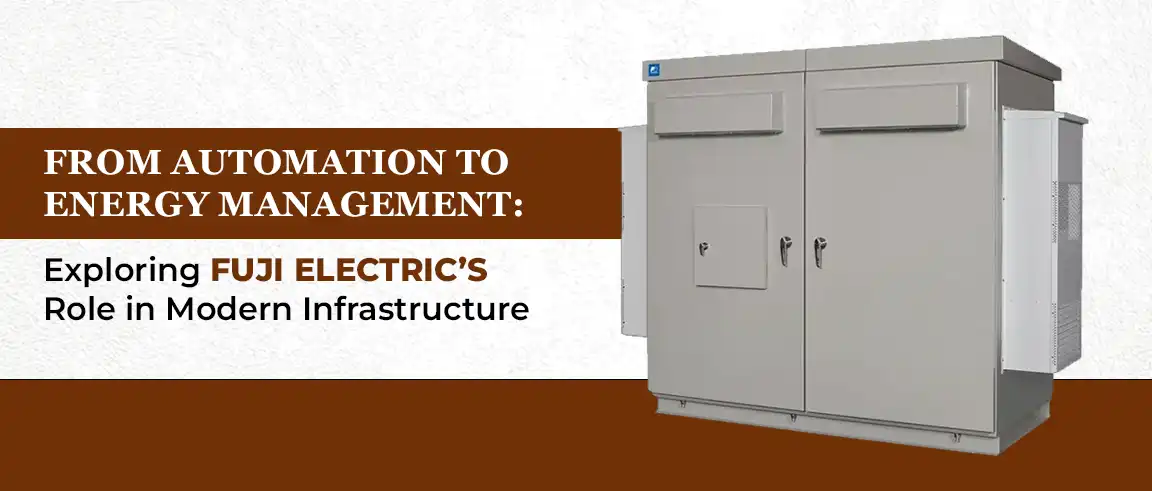
Industrial infrastructure is quietly undergoing a structural shift. What was once a clear separation between automation systems and energy management is now becoming increasingly integrated. Production facilities are no longer evaluated only on output efficiency they are assessed on how intelligently they consume, distribute, and optimize energy.
In this transition, manufacturers and system integrators often look toward established engineering-driven brands such as Fuji Electric, not for trend-led innovation, but for consistent, system-level reliability.
There is also a growing realization across industries:
Automation without energy awareness leads to inefficiencies, while energy systems without automation lack responsiveness.
Fuji Electric’s role in modern infrastructure spans industrial automation and energy management systems, offering components and solutions that enable efficient control, monitoring, and optimization of electrical and mechanical processes. These systems help industries improve operational stability, reduce energy consumption, and maintain long-term reliability.
Historically, automation systems focused on:
Energy systems, on the other hand, were largely reactive designed to supply power without dynamic optimization.
This separation is gradually dissolving.
Today’s infrastructure demands:
Fuji Electric’s product ecosystem ranging from drives and PLC-linked components to switchgear sits at this intersection. Not as a single “solution,” but as interconnected building blocks within larger systems.
When examined from both automation and energy perspectives, several technical attributes become central:
Core Engineering Features:
These features are often evaluated not independently, but in terms of how they influence system-level energy behavior.
The transition from automation to energy management is also reflected in material choices and manufacturing precision.
Material Considerations:
Production Methodology Insights:
In practice, energy efficiency is rarely a single feature it is the outcome of multiple small engineering decisions working together.
A common assumption is that energy-efficient systems are more delicate. In reality, durability and efficiency often reinforce each other.
Key Performance Dimensions:
In manufacturing environments where equipment runs continuously, even minor inefficiencies compound over time. Systems that maintain stable performance under these conditions tend to deliver both durability and energy savings.
The integration of automation and energy management becomes visible across multiple sectors:
Industrial Applications:
Environmental Conditions:
These conditions highlight why both automation precision and energy efficiency must coexist.
Rather than comparing brands, it is often more useful to compare system approaches.
Automation-Centric vs Energy-Integrated Systems
Approach |
Focus |
Strength |
Limitation |
|
Automation-Centric |
Process efficiency |
High control precision |
Limited energy optimization |
|
Energy-Centric |
Power management |
Reduced energy consumption |
Less responsive automation |
|
Integrated Systems |
Combined optimization |
Balanced efficiency & control |
Higher system complexity |
Fuji Electric components are typically deployed within integrated systems, where both control and energy behavior are aligned.
When evaluating Fuji Electric for modern infrastructure applications, consider:
A key insight:
Procurement decisions increasingly shift from component-level evaluation to system-level thinking.
Fuji Electric supports energy efficiency through components like variable frequency drives, low-loss switchgear, and optimized control systems that reduce energy consumption while maintaining operational stability.
Yes, automation systems can significantly influence energy usage by adjusting machine operation based on real-time demand, reducing unnecessary power consumption.
They are commonly used as part of integrated systems where automation and energy monitoring work together to improve efficiency and reliability.
Manufacturing, HVAC, process industries, and infrastructure sectors benefit the most due to their high energy consumption and need for continuous operation.
Yes, integration can increase system complexity, but it also improves long-term efficiency,control, and operational predictability.
In large-scale infrastructure projects, supply reliability often determines implementation success.
BE Electricals, operating from Delhi, supports Pan-India distribution of Fuji Electric automation and switchgear components. This includes coordination with industrial buyers, system integrators, and distributors across regions.
For detailed product insights and specifications, refer to:
https://www.beelectricals.com/fuji-electric-automation-and-switchgears-product
Supply considerations typically include:
These factors become particularly important in infrastructure projects where delays can cascade across multiple systems.
The boundary between automation and energy management is no longer clearly defined. Modern infrastructure demands systems that are both responsive and efficient, capable of adapting to real-time conditions while maintaining operational stability.
Fuji Electric’s role in this space is not about offering isolated products, but about enabling this convergence through engineering consistency and system compatibility.
For procurement teams and engineers, the real challenge lies in evaluating not just what a component does but how it behaves within a larger system.
If you are assessing these systems for an upcoming project, taking time to evaluate operational conditions, integration requirements, and long-term performance can help reduce risks. For further technical insights or product details, you can reach out to BE Electricals:
https://www.beelectricals.com/contact-us