Ready to Start you Retail Chain?
Become Top Products Retailer
Get Brand Tools, Machinery, Accessories and Equipment and Start your Retail Business

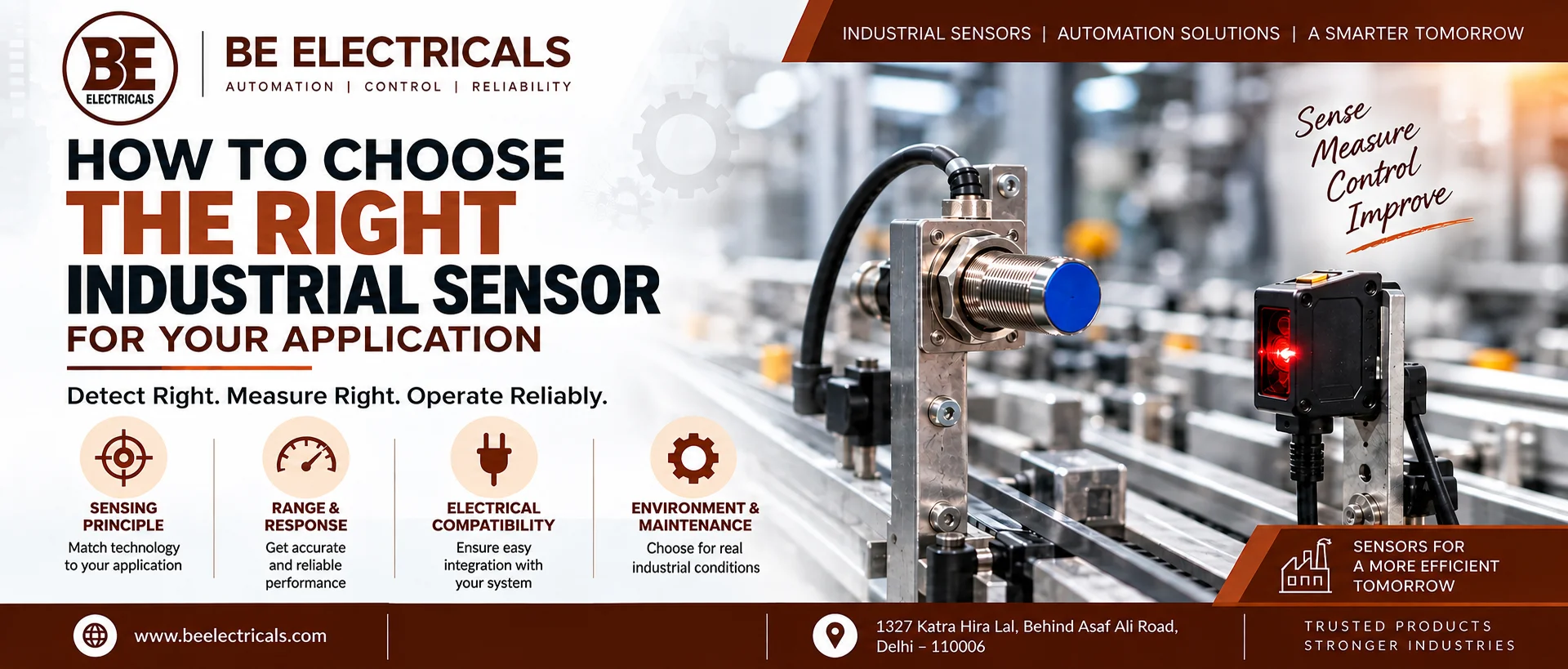
A sensor works during a maintenance check, then misses parts when the line returns to full speed. Another gives stable readings on the bench but becomes unreliable beside a hot machine.
The device may not be faulty. It may simply be wrong for the conditions in which it has to work.
Choosing an industrial sensor means matching the sensing method, installation and output signal to a specific job. The best option is the one that detects or measures reliably through the normal variations of production, while remaining straightforward to replace and maintain.
For procurement teams, that means looking beyond the part number and price. For engineers, it means giving the supplier enough application detail to evaluate the options. This guide covers the main types of industrial sensors, the checks that matter before purchase and how to prepare an enquiry for BE Electricals.
Choose an industrial sensor by defining what you need to detect or measure, then checking its sensing principle, operating range, response time, environment, mounting and controller compatibility. Compare shortlisted models against the same requirements and test difficult applications using real production conditions before ordering in quantity.
“Is the metal part present?” calls for a detection function. “What is the compressed-air pressure?” calls for measurement. A pressure switch can provide a threshold signal, while a transmitter can provide a continuously varying value. Some devices provide both.
That decision narrows the product search immediately.
An industrial sensor detects a physical condition and converts it into a signal that a machine, controller or monitoring system can use.
It might detect the presence of a component, identify a cylinder position or measure pressure, temperature, level or flow. These are different tasks, so their specifications should not be compared as though they were interchangeable products.
For a detection sensor, repeatable switching may be the priority. For a measurement device, accuracy across the working range may matter more. The application determines which specification deserves attention.
The following table provides a starting shortlist. Final selection still depends on the target, process and installation.
| Sensor type | Applications worth evaluating | Main selection check |
|---|---|---|
| Inductive proximity sensor | Metal-part presence and machine position | Actual metal, target size and mounting clearance |
| Capacitive proximity sensor | Material presence or point-level detection | Material properties, deposits and surrounding objects |
| Photoelectric sensor | Product counting, conveyor detection and packaging | Optical arrangement, target appearance and background |
| Ultrasonic sensor | Distance, presence and suitable level applications | Blind zone, target angle and usable echo |
| Magnetic sensor | Position detection using a compatible magnet | Magnet arrangement and mounting compatibility |
| Pressure sensor | Pneumatic, hydraulic and process monitoring | Pressure reference, range, media and output |
| Temperature sensor | Equipment and process temperature measurement | Temperature range, installation and input compatibility |
| Flow or dew-point sensor | Utility performance and air-quality monitoring | Medium, installation conditions and measurement range |
A proximity sensor detects an object without physical contact. In industrial catalogues, the term often refers to inductive, capacitive or magnetic devices, although broader definitions include other non-contact technologies.
Inductive sensors are commonly shortlisted for conductive metal targets. Capacitive sensors can respond to suitable metallic and non-metallic materials, including some liquids and powders.
For metal detection, identify the actual target material rather than specifying only “metal.” For capacitive detection, include information about the container wall, surrounding material and possible deposits.
A photoelectric sensor detects changes in received light. Different optical arrangements suit different installation constraints.
| Optical arrangement | How detection works | Practical consideration |
|---|---|---|
| Through-beam | A target interrupts light between separate emitter and receiver units | Requires installation access on both sides |
| Retro-reflective | A target interrupts light returning from a reflector | Needs a suitable reflector and correct handling of reflective targets |
| Diffuse-reflective | The receiver detects light returned by the target | Target colour, angle and background can affect detection |
Background-suppression and clear-object models address particular detection challenges, but their limits still need checking.
An ultrasonic sensor uses sound for detection or distance measurement. It can be worth evaluating where transparency or colour makes optical sensing difficult. Check the blind zone, mounting angle and application conditions rather than assuming every target produces a useful echo.
Pressure sensors serve a different purpose: monitoring or measuring pressure in suitable gases and liquids. Their selection requires attention to process connections and media compatibility as well as electrical specifications.
Describe the job in terms the supplier can evaluate.
For object detection, record the material, dimensions, colour, surface finish, orientation and movement. Include the smallest target and the least favourable position the device must handle.
For process measurement, record the medium, normal operating range, expected peaks and required measurement point. “Air pressure” is incomplete without identifying where the pressure is measured and what the controller needs to do with the reading.
A useful enquiry might say: “Detect each aluminium bracket at the inspection station, including the smallest approved bracket, at maximum conveyor speed.” That is much clearer than “Send your best proximity sensor.”
The headline range is only part of the specification.
For an inductive device, compare the rated target conditions with the actual metal and geometry. Use the manufacturer’s specified operating distance and mounting instructions rather than installing at the edge of the advertised range.
Flush and non-flush mounting requirements also matter. Nearby metal or another sensor can affect operation.
For optical sensing, allow for target movement and realistic alignment tolerances. For ultrasonic sensing, ensure the target remains outside the specified blind zone.
These terms answer different questions.
Accuracy describes closeness to the reference value under stated conditions. Repeatability describes how consistently a measurement or switching point recurs under the same conditions. Resolution describes the smallest change that can be represented or distinguished.
A display with more digits does not automatically provide better accuracy.
Check how the manufacturer expresses the error. For example, if a hypothetical 0–100 bar transmitter specifies accuracy of ±0.5% of full scale, that corresponds to ±0.5 bar under the stated conditions. At a 10 bar reading, that is 5% of the reading, before considering other applicable errors.
This calculation illustrates why unnecessarily wide ranges can be unsuitable for low-pressure measurements. Also check temperature effects and whether the quoted accuracy is only one part of the total error.
A device can detect the correct material and still miss it if the target passes too quickly.
Consider target speed, target width, spacing and the time available for both detection and reset. The controller’s input filter and scan or task timing also affect whether it captures the signal.
As an illustration, a 10 mm target moving at 1 metre per second occupies a fixed detection point for roughly 10 milliseconds. That is only a starting estimate: beam width, target geometry and sensor behaviour affect the actual pulse.
Review the complete signal path and test at the fastest operating condition. A sensor’s quoted switching frequency alone does not guarantee the PLC will capture every event.
Matching the connector shape is not enough.
Check supply voltage, wiring arrangement, output type, load limits and the controller input. A replacement that looks identical may have a different output or pin assignment.
For common DC switching outputs, PNP devices source current towards the load, while NPN devices sink current towards the negative supply. Match the sensor to the input module’s documented circuit and common connection.
Normally open and normally closed describe output behaviour under defined conditions; they do not replace the PNP/NPN check. Optical devices may also specify light-on or dark-on operation.
For measurement devices, verify the required analogue signal or digital interface, scaling and fault indication. An IO-Link-capable device needs a compatible master to use its IO-Link functions; confirm what conventional switching operation it supports separately.
Use the exact manufacturer wiring diagram before installation.
Record the conditions at the sensor, not just the general factory temperature.
A device beside a hot pipe can face a different temperature from the surrounding room. A unit exposed to coolant needs compatible housing, seals, cables and connectors.
Check dust, water exposure, cleaning chemicals, vibration, electrical noise and the risk of physical impact.
An IP rating describes particular ingress-protection conditions. It does not establish chemical compatibility, and immersion protection should not be assumed to cover every high-pressure cleaning method. Confirm the specific tests and installation requirements.
Where hazardous-area or safety functions apply, have the responsible engineer verify the required approvals and system design. An ordinary detection sensor should not be treated as a personnel-protection device.
Ask how the sensor will be cleaned, adjusted and replaced during normal maintenance.
A device mounted where nobody can reach it may be inexpensive to purchase but difficult to maintain. Consider cable routing, bracket stability, connector access and whether replacement requires recalibration or teaching.
For measurement applications, define calibration needs according to process risk and the quality system. Not every sensor needs the same interval or type of verification.
Keep a record of the exact part number, settings, wiring and approved substitutes. This is especially useful when the same machine has several visually similar sensors.
For a short-distance metal-detection task, an inductive proximity sensor is often a sensible first option. For product detection across a conveyor or a target that is not metal, a suitable photoelectric sensor may be more appropriate.
However, the broader term “proximity sensor” includes several technologies. Compare an identified sensing principle with an identified optical arrangement.
Consider two illustrative applications.
Metal bracket in a machining fixture: Shortlist an inductive device, then test the real bracket material, minimum target size and mounting position. Include normal contamination and vibration in the assessment.
Clear bottles on a packaging conveyor: Do not assume a standard diffuse sensor will work consistently. Evaluate a clear-object optical solution or another suitable technology using representative bottles, labels, fill conditions and background equipment.
Neither choice is universally better. A successful trial should show reliable detection across the approved product variations, not just one clean sample.
Once the application requirements are clear, compare exact models within the relevant brand ranges. A familiar brand name is useful for sourcing, but it cannot establish compatibility on its own.
BE Electricals supplies Carlo Gavazzi inductive, capacitive, photoelectric and magnetic sensors. These are relevant starting points for enquiries involving part presence, product counting or position detection.
For a proximity sensor enquiry, specify the sensing principle and target material. For a photoelectric sensor, include the optical arrangement, distance and available mounting space. Ask for the exact model datasheet with the quotation.
Explore the Carlo Gavazzi sensor rangeto start a product enquiry. Confirm the output, accessories and availability of the selected part number before ordering.
The OMRON range at BE Electricals includes proximity and photoelectric sensors, along with other sensing products. Use the application specification to narrow the options before comparing prices.
For example, a conveyor enquiry should include the smallest product, maximum speed and background conditions. If the current sensor misses items, describe when it happens and share the existing model number.
Review OMRON industrial automation products when preparing your shortlist. Confirm model-specific performance rather than assuming that products from the same brand behave identically.
BE Electricals also lists brands such as Balluff, Banner, Baumer, IFM, Keyence and SICK in its brand directory. Ask which exact models meet your specification and can be supplied within the required lead time.
For cross-brand replacements, request a written comparison covering dimensions, sensing distance, output, pin assignment and environmental ratings. Record any change to brackets, cables or controller settings.
BE Electricals handles small and bulk enquiries for delivery across India. Specify whether you need one replacement, a production quantity or maintenance spares, and confirm stock, delivery and warranty arrangements in the quotation.
There is no meaningful single price for an industrial sensor. A basic switching device and a calibrated process transmitter have different functions and costs.
Compare exact models against one specification, then review what is included.
| Quotation item | What to verify |
|---|---|
| Sensor | Exact model, output, range and environmental suitability |
| Accessories | Cables, connectors, brackets, reflectors or process adapters |
| Engineering | Wiring changes, scaling, programming and commissioning |
| Verification | Application trial or calibration documentation, where needed |
| Maintenance | Cleaning access, replacement procedure and support |
| Supply | Availability, warranty route and replacement lead time |
A more expensive sensor can be better value if it demonstrably reduces missed detections or adjustment time. Additional features have little value when the controller cannot use them or the application does not need them.
For Indian procurement, confirm applicable taxes, freight, delivery location and support arrangements. Where authorised distribution is claimed, verify it with the manufacturer.
A useful trial reproduces the conditions most likely to cause trouble.
Use the smallest and largest approved targets, expected colour or surface variations, maximum speed and realistic mounting tolerances. Include normal lighting changes and contamination where relevant.
Record missed detections, false triggers and the stability of the switching point. For measurement devices, compare results with a suitable reference over the required working range.
Agree acceptance criteria before the trial. “It appeared to work” is not enough for a device controlling product counting or an important process decision.
For a replacement, also verify output logic and controller behaviour. A mechanically compatible substitute should not be released into production solely because it fits the bracket.
Provide the application, required quantity, target or medium, operating range and environment. Add photographs or a drawing showing the mounting space and sensing direction.
For an existing machine, include the current part number, wiring diagram, controller input details and a description of the failure or limitation.
State whether you need hardware only, installation support, a trial or calibration documentation. Ask the supplier to identify any assumptions and technical deviations in writing.
A clear enquiry makes it easier to compare recommendations and reduces the chance of receiving a quotation for a superficially similar device.
An inductive proximity sensor is often a suitable starting point for short-distance metal detection. Confirm the actual metal, target dimensions, required distance and mounting arrangement. The rated distance for one reference target may not apply to every metal.
Some capacitive proximity sensors can detect suitable plastic targets. Inductive sensors generally detect conductive metal instead. Choose the sensing principle according to the material, geometry and operating conditions, then verify performance in the application.
Consider a photoelectric sensor for product presence, counting or detection where optical sensing suits the target and installation. Choose through-beam, retro-reflective or diffuse operation according to access, target appearance, distance and background conditions.
Clear-object photoelectric models and suitable ultrasonic sensors are options to evaluate. Test the actual object, thickness, position and operating speed. Standard optical settings should not be assumed reliable for every transparent product.
In common DC switching circuits, a PNP output sources current, while an NPN output sinks current. The correct choice depends on the controller input and wiring. Follow the exact sensor and input-module diagrams.
No. Ingress protection is one requirement. Chemical exposure, temperature, vibration, cleaning methods and connector installation also affect suitability. Check the specific environmental conditions covered by the manufacturer.
No. Measurement instruments may need calibration according to process and quality requirements. Presence-detection sensors more commonly need functional checks, correct adjustment and verification of reliable switching. Follow the applicable maintenance procedure.
Yes, if the substitute is technically approved for the application. Compare sensing behaviour, dimensions, output, wiring, response time, environmental suitability and settings. Test the replacement before accepting it as an interchangeable spare.
Whether you need a proximity sensor for metal detection, a photoelectric sensor for a packaging line or a replacement for an existing device, send BE Electricals your application details and preferred part number. Include the target material, sensing distance, output type, quantity and delivery location so the enquiry can be checked against the available options. Contact BE Electricals to discuss product selection, pricing and availability, and request a quotation that identifies the exact sensor and accessories your machine needs.