Ready to Start you Retail Chain?
Become Top Products Retailer
Get Brand Tools, Machinery, Accessories and Equipment and Start your Retail Business

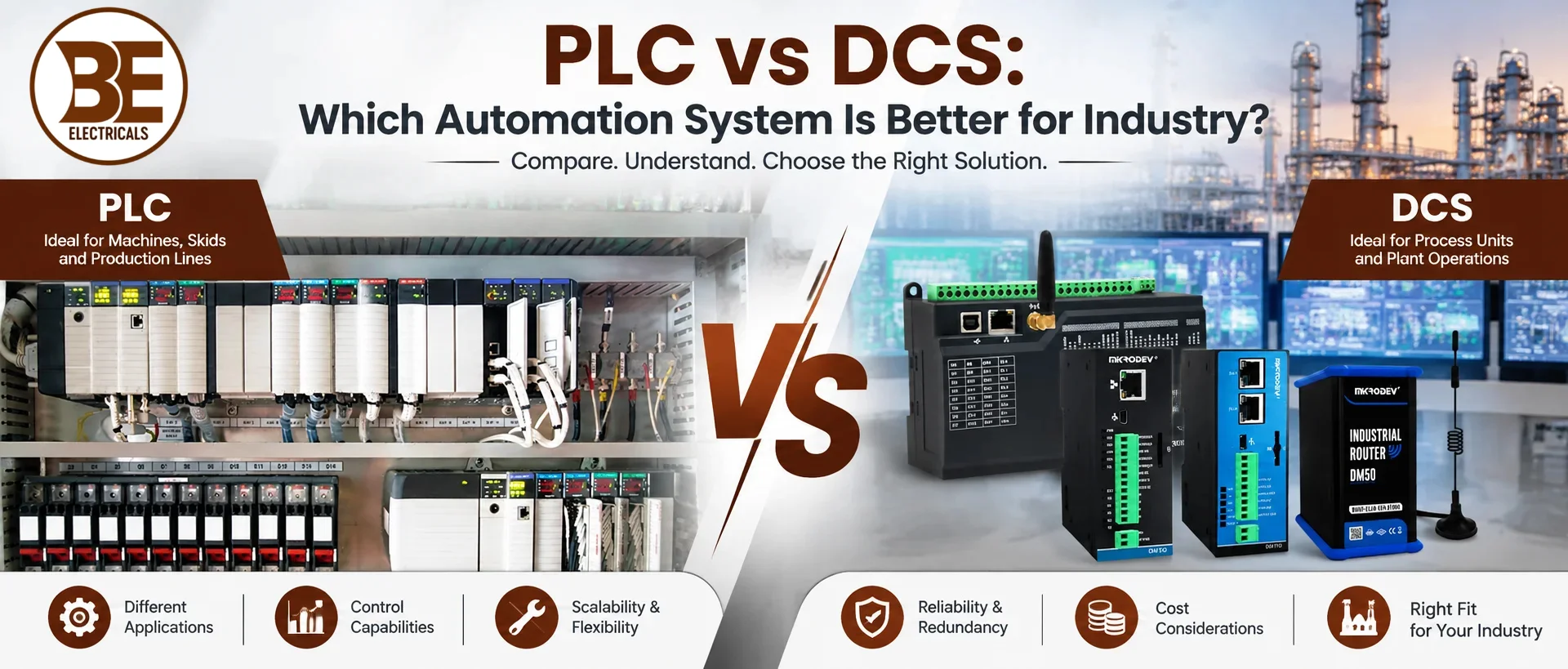
A packaging machine and a chemical process unit may both need automatic control, but the people buying those systems face different problems.
One team may need accurate sequencing and quick fault recovery on a production line. Another may need operators to manage interacting process units from a control room, with consistent alarms, trends and operating procedures.
That is where the PLC vs DCS decision becomes useful.
The right choice depends on what you need to control, how the plant is operated and what it will cost to support the system over its working life. For procurement teams, the comparison should also cover the controllers, networking and field components needed to turn the proposed architecture into a working installation.
A PLC system is often a practical starting point for individual machines, packaged equipment and production lines. A DCS system is often a strong fit for interconnected continuous or batch processes that need coordinated control and a consistent operator environment. Many industrial plants use both.
Neither option is automatically better for every industry. Modern platforms overlap considerably, so compare complete proposed systems rather than choosing from the acronym alone.
| Buying consideration | PLC system | DCS system |
|---|---|---|
| Common starting application | Machines, skids and production lines | Integrated process units and plant operations |
| Control capability | Sequencing, motion and process control, depending on platform | Continuous and batch control, plus sequencing |
| Engineering approach | May combine controller, HMI and supervisory tools | Typically provides an integrated engineering environment |
| Operator interface | Local HMI or wider SCADA environment | Coordinated process graphics, alarms and trends |
| Redundancy | Available on selected platforms and architectures | Commonly offered, but scope must be verified |
| Expansion | Additional machines, controllers, I/O or software | Additional units, controllers, I/O or software |
| Cost comparison | Often attractive for a limited machine scope | Can be competitive where integration requirements are extensive |
| Main procurement question | What must be engineered and integrated separately? | What is included, licensed and supported throughout the lifecycle? |
These are typical buying patterns, not fixed limits on what either technology can do.
A programmable logic controller, or PLC, is an industrial controller that reads inputs, executes programmed logic and updates outputs.
A complete PLC system usually includes the controller, input/output modules, power supplies, communication equipment and programming tools. An operator interface is added where required.
On a production machine, the PLC might check that a part is present, confirm a clamp has closed and then permit the next operation. It can also regulate process variables when the selected hardware and software support that task.
Modern programmable controllers extend beyond basic on/off logic. Rockwell Automation describes platforms for machine control, motion, batching and process applications. This is why “PLCs cannot handle process control” is an unreliable buying assumption. Source: Rockwell Automation programmable controllers.
The practical question is whether the proposed platform meets your timing, capacity, integration and support requirements.
A distributed control system, or DCS, coordinates control across a process using multiple controllers and a shared engineering and operating environment.
“Distributed” refers to the control architecture. It does not mean that operators lose a central view of the plant.
A DCS system commonly brings together control configuration, process graphics, alarms and historical information. Capabilities such as batch management and advanced control may be available, but their inclusion depends on the quotation and licensing.
The value is often in how consistently the plant can be engineered, operated and maintained as its processes become more connected.
Start with the physical process.
Does the application involve fast machine events, coordinated movement, slowly changing temperatures or several interacting pressure and flow loops? Write down the response requirements before comparing controller specifications.
A catalogue scan time is not the complete response time. Input acquisition, task scheduling, communications, output updates and actuator movement all contribute.
Ask the supplier to demonstrate performance under the expected application load. Avoid universal claims that every PLC is faster than every DCS, or that one technology always provides better control accuracy.
A PLC-based project may offer considerable freedom in the selection of HMI, SCADA, historian and networking products. That flexibility also requires someone to own the interfaces and maintain consistency.
A DCS often provides a more unified workflow for configuring control functions and related operator information. This can be useful when the same equipment patterns repeat across many process units.
Compare the work involved in a realistic change. If a new pump is added, how are its logic, alarms, graphics, history and documentation updated? Which tasks are automatic, and which require separate engineering?
That exercise is more revealing than a general promise of “easy integration.”
An industrial automation system must help people understand what is happening during normal operation and when something goes wrong.
For a standalone machine, a clear local HMI may be sufficient. For a process plant, operators may need a common view of several units, prioritised alarms and trends that explain how a disturbance developed.
Review sample screens and alarm behaviour before purchase. Ask an operator to work through a simulated fault using the proposed interface.
The better option is the one that makes the required operating decisions clear without unnecessary screen changes or conflicting information.
Both PLC and DCS architectures can support redundancy, depending on the selected products and design.
Two controllers alone do not make the entire system redundant. Power supplies, I/O, networks, servers and field devices can still introduce single points of failure.
Ask what happens when each critical component fails. Does control continue? Can operators still see the process? What interruption occurs during switchover, and how is the failed component restored?
Specify acceptable failure behaviour in the enquiry and test it during acceptance. “High availability” needs a defined scope.
Consider the people who will support the system after commissioning.
They need access to current project files, compatible engineering software, backups and useful documentation. They also need a clear route for obtaining replacement parts and technical help.
Expansion should be assessed beyond spare I/O terminals. Controller capacity, network loading, server resources, licences and cabinet space may all affect the next project.
Ask suppliers to price one realistic future addition. This helps expose costs that are easy to overlook in the initial proposal.
Neither the PLC nor DCS label establishes that a system is secure. Review access controls, network separation, remote-support arrangements, backup recovery and the supplier’s update process.
Functional safety is a separate engineering decision. A standard controller or a redundant control system should not be assumed to fulfil a required safety function. Define safety requirements through the relevant assessment and verify the complete safety solution.
A PLC system deserves early consideration when the project has clear machine or equipment boundaries.
Examples include a packaging machine, conveyor line, assembly station or independently controlled utility package. The plant may benefit from local operation, a familiar maintenance platform and the ability to add equipment in stages.
A PLC-based solution can also suit process applications. The deciding factor is whether the complete configuration provides the required control, operator functions and support at an acceptable lifecycle cost.
Shortlist a PLC approach when:
A small hardware quotation is only attractive if it includes—or allows for—everything required to operate the system.
A DCS system deserves close evaluation when several process areas need to operate as a coordinated whole.
Continuous processing and complex batch production can place substantial demands on alarm management, consistent control strategies, operator visibility and change management.
A DCS may offer value by reducing the amount of separate integration needed across these functions. That benefit should be demonstrated against the actual project scope.
Shortlist a DCS approach when:
There is no universal I/O count at which a plant must switch from PLC to DCS. Application complexity and operating needs matter alongside size.
Yes. A plant can use PLCs or dedicated controllers for packaged equipment while a DCS supervises the wider process.
This arrangement allows equipment to retain its local control functions while sharing agreed information with plant operators.
The important work is defining the interface. Agree which system owns start permissions, setpoints, operating modes, alarms and reset commands.
Also decide what happens if communications are lost. A display should not continue showing an old value as though it were current, and critical equipment behaviour should follow the approved control and protection design.
Once your engineering team has chosen the architecture, turn it into a bill of materials with exact product references. This makes it easier to compare supply quotations and identify missing components before installation.
BE Electricals supplies Siemens PLC controllers and industrial Ethernet switches. Its Siemens industrial automation range is a relevant starting point for controller and network-component enquiries. Confirm the exact order codes, firmware requirements and compatibility with the approved engineering software.
The wider BE Electricals brand directory includes automation and electrical ranges such as ABB, OMRON, Carlo Gavazzi and Harting. Match each required sensor, drive, connector or panel component to the approved design before requesting a quotation.
For projects involving motion or motor control, the Allen Bradley product range at BE Electricals includes servo drives, contactors and motor starters. Their presence in a catalogue does not establish compatibility with every controller; confirm the selected interface and operating requirements.
A component quotation should define the hardware being supplied. For a complete PLC system or DCS system, separately confirm responsibility for architecture, software licences, programming, panel work and commissioning with the system provider or automation integrator.
Ask the component supplier and system integrator to agree:
BE Electricals handles small and bulk product enquiries for delivery across India. Provide the required quantities and delivery location, and request model-specific availability and lead times. For any proposed DCS package, confirm the platform and project scope directly before treating it as an available supply option.
A PLC approach often has a lower entry cost for a limited machine application. A DCS may become commercially attractive when extensive integration, process operation and lifecycle support are included.
The fair comparison is between two solutions that meet the same requirements.
| Cost item | What to compare in both proposals |
|---|---|
| Hardware and panels | Controllers, I/O, power supplies, networking and cabinet scope |
| Software | Engineering, operator stations, history, batch and licence limits |
| Engineering | Logic, graphics, alarms, interfaces and documentation |
| Availability | Redundancy scope, switchover testing and recovery arrangements |
| Commissioning | Factory tests, site tests and production shutdown requirements |
| Training and handover | Operator training, maintenance training and editable project files |
| Lifecycle support | Service terms, updates, spares and future migration |
| Expansion | Cost of adding a realistic machine, skid or process unit |
A lower initial price can lose its advantage if interfaces, operator screens or licences are excluded. Equally, a comprehensive platform can be poor value if the plant pays for capabilities it does not need.
Use a common evaluation period and include recurring charges, planned upgrades and internal engineering effort. Treat projected downtime savings as assumptions until they are supported by plant data.
Give bidders one requirements document so their proposals can be compared on the same basis.
Describe the process, existing equipment, I/O types, control loops, sequencing needs and expected response times. Include operator stations, alarm expectations, historical data requirements and planned expansion.
For an existing plant, also provide the current architecture, available drawings, software versions and permitted shutdown windows. Retaining working equipment may be more practical than replacing an entire control system.
Define acceptance before placing the order. Factory acceptance testing should check the agreed logic, interfaces and fault scenarios as far as practical before delivery. Site acceptance testing should confirm the installed system and its behaviour with the actual equipment.
For Indian projects, confirm local support coverage, delivery terms, applicable taxes and the arrangements for replacing imported components. Separate confirmed support commitments from general statements about nationwide service.
Comparing a controller price with a complete system price. One offer may exclude the HMI, history, networking or engineering included in the other.
Choosing only by industry label. A chemical plant may use PLC-controlled packages, while a manufacturing site may have process areas that justify DCS evaluation.
Assuming redundancy guarantees safety. Availability and functional safety have different objectives and must be assessed accordingly.
Leaving integration until commissioning. Undefined signal ownership and communication behaviour can create expensive site changes.
Ignoring handover. Without current backups, project access and training, the plant can become dependent on outside support for routine changes.
A PLC is a programmable controller used within a control solution. A DCS is a distributed control architecture typically supplied with an integrated engineering and operator environment. In practice, compare a complete PLC-based system with a complete DCS proposal.
A PLC system is often a suitable starting point for machines and production lines. A DCS system may suit interconnected process areas with substantial control-room requirements. Many manufacturing plants benefit from using both at different levels.
Yes. Suitable PLC platforms can perform continuous process control, including PID loops. Evaluate the complete solution’s capacity, engineering tools, operator functions and availability requirements rather than assuming process control requires a DCS.
No. A PLC solution often costs less for a small machine scope, but the total depends on software, engineering, integration, redundancy and support. Compare equivalent requirements over the same evaluation period.
Reliability depends on the selected products, architecture, installation and maintenance. Both approaches can support high-availability designs. Compare failure points, recovery procedures and tested switchover behaviour rather than the system label.
Yes, through supported interfaces and agreed data mappings. Confirm the exact protocols, signal meanings, update rates, command permissions and communication-loss behaviour. Compatibility needs to be verified for the selected equipment.
SCADA provides supervisory control and data acquisition, often above PLCs or other controllers. A DCS typically integrates distributed process control with engineering and operator functions. Their capabilities overlap, so assess the proposed architecture and included applications.
BE Electricals lists Siemens PLC controllers and Ethernet switches, alongside other automation and electrical products. Send the approved bill of materials with exact part numbers, quantities and delivery requirements. Confirm programming, software and commissioning requirements separately from the component supply quotation.
Your PLC vs DCS decision should lead to a clear specification that procurement and engineering can both use. Share your approved architecture, component list and preferred brands with BE Electricals to discuss relevant automation products, pricing and availability. Include exact part numbers where available, required quantities and your project timeline so the quotation reflects what you actually need. Contact BE Electricals to start your enquiry and confirm the supply scope alongside your automation integrator before placing the order.