Ready to Start you Retail Chain?
Become Top Products Retailer
Get Brand Tools, Machinery, Accessories and Equipment and Start your Retail Business

A sensor that misses one component every few minutes can create a surprisingly expensive problem. Operators stop the line, adjust the bracket and restart production. The fault disappears during inspection, then returns with a different product or at full speed.
Sometimes the device needs replacing. Sometimes the sensing method was unsuitable from the beginning.
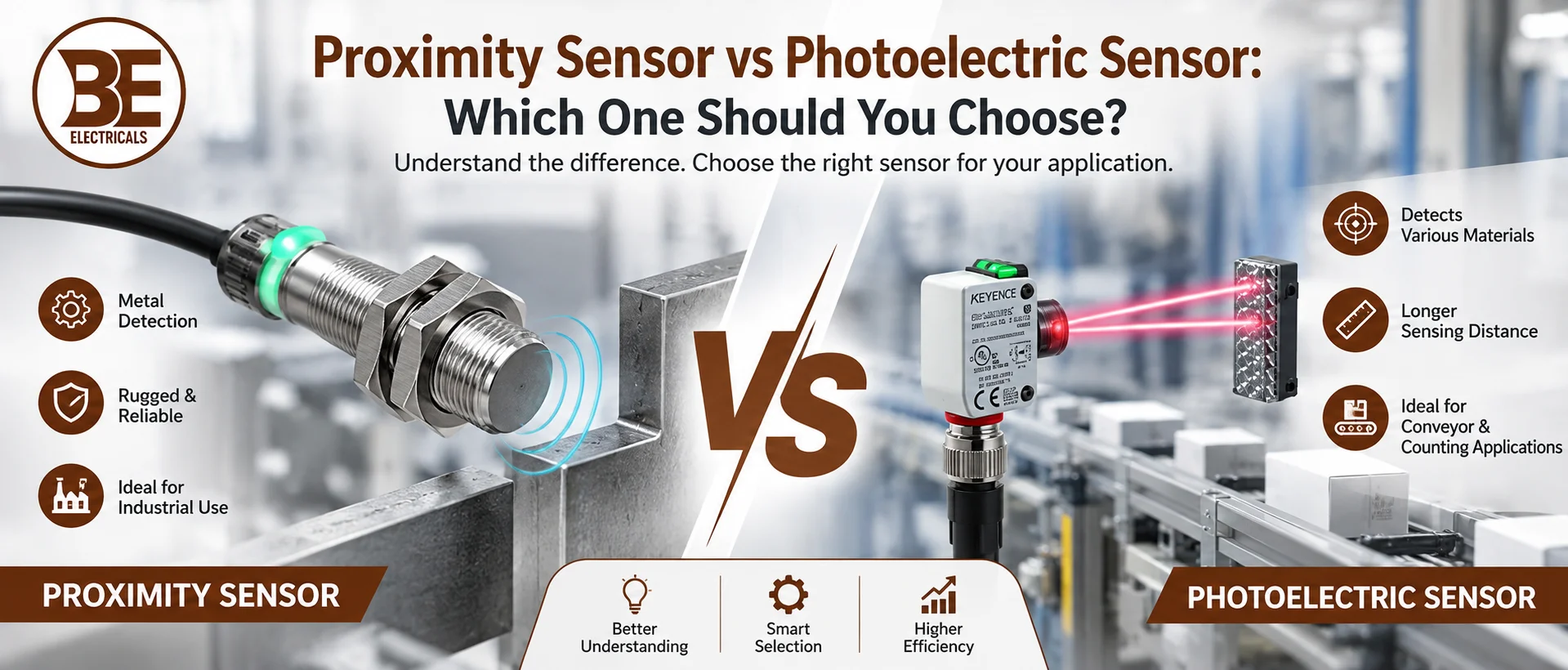
The proximity sensor vs photoelectric sensor decision starts with the object, detection distance and conditions around the machine. This guide helps maintenance engineers and procurement teams compare the options, check the installation requirements and prepare a useful enquiry for BE Electricals.
Choose an inductive proximity sensor for nearby metal detection when the target and mounting arrangement suit its specified range. Consider a photoelectric sensor for conveyor counting, varied materials or a longer detection path. Evaluate capacitive proximity sensing for suitable non-metallic materials or level detection. Verify the exact model under production conditions before ordering in quantity.
One clarification matters: proximity sensor is a broad term for non-contact detection. In many purchasing conversations, it means an inductive device. Here, the main comparison is inductive proximity sensing versus photoelectric sensing, with capacitive and magnetic alternatives explained separately.
| Buying factor | Inductive proximity sensor | Photoelectric sensor |
|---|---|---|
| Detection principle | Responds to conductive metal | Detects changes in received light |
| Typical task | Metal position or part presence | Product counting and presence detection |
| Target material | Conductive metals within specified limits | Many materials, with suitable optical settings |
| Working distance | Usually close to the target | Often offers greater installation distance |
| Main influences | Metal type, target size and surrounding metal | Optical arrangement, target appearance and background |
| Installation needs | Correct clearance and mounting geometry | Clear optical path and stable alignment |
| Maintenance focus | Impact damage, deposits and loose mounting | Lens or reflector cleanliness and alignment |
| Purchase decision | Verify actual target and assured operating distance | Verify target variations and optical margin |
These are selection tendencies, not guaranteed specifications. The model datasheet and an application trial should determine the final choice.
An inductive sensor generates an electromagnetic field and responds when conductive metal enters the sensing area. Common applications include confirming a metal bracket, detecting a machine position or checking that a metal component has reached a fixture.
Different metals can produce different usable distances. An advertised range does not automatically apply to aluminium, stainless steel and a standard steel test target equally. Some specialised sensors address this difference;
Specify the real target rather than writing only “metal sensor” in a purchase enquiry.
Capacitive sensing responds to changes in capacitance. It can suit some plastics, powders and liquids, including certain detection tasks through a non-metallic container wall. Container thickness, deposits and surrounding material still require evaluation.
Magnetic sensors detect an appropriate magnetic target and are often considered for compatible cylinder-position applications. They are not interchangeable with an inductive sensor merely because both provide a switching signal. OMRON’s proximity sensor overview explains these sensing principles and terminology.
A photoelectric sensor uses an emitter and receiver to detect a change in light. The arrangement determines whether the target interrupts a beam or reflects light towards the receiver.
Through-beam sensing uses separate emitter and receiver units. Retro-reflective sensing uses a sensor and reflector. Diffuse sensing receives light reflected from the object itself. These differences affect installation access and how much target appearance matters. OMRON’s photoelectric overview provides the underlying operating principles.
Through-beam is worth considering when both sides of the detection path are accessible. The target interrupts the beam, so the arrangement can provide a useful starting point for counting suitable opaque products. Budget for mounting and wiring both units.
Retro-reflective places the emitter and receiver together, with a reflector opposite. It can simplify wiring, but the reflector needs a stable position. Reflective targets and transparent products require suitable models and careful evaluation.
Diffuse sensing needs no separate reflector. This can help where access is limited, although returned light depends on the object and installation. A dark product, shiny surface or nearby background may change performance.
Background-suppression models can help separate the target from objects behind it. They still have operating limits, including target-dependent effects. Banner’s sensing-mode guide explains when this arrangement is useful.
A quotation that says only “photoelectric sensor” leaves too much unresolved. Ask for the sensing mode and all required accessories.
Describe everything the sensor must detect during a normal shift. Include material, dimensions, colour, finish, orientation and any packaging changes.
For metal sensing, test the smallest approved component and the least favourable position. For optical sensing, test dark, reflective and transparent variants where relevant. A sensor selected using one clean sample may behave differently with the actual product mix.
Consider what it must ignore as well. A passing fixture, machine frame or background conveyor can be as important as the target.
Measure the closest and furthest target positions, allowing for vibration and normal movement. Choose an operating position within the manufacturer’s recommended limits, with sufficient margin for these variations.
For inductive devices, check flush or non-flush mounting requirements and nearby metal. For photoelectric devices, check the beam path, alignment access and room for a reflector or receiver.
Avoid moving a sensor to its maximum catalogue distance simply to make an existing bracket convenient. Reworking the mounting position may produce a more dependable installation.
The sensor must detect the target and reset before the next event. Check both response time and the manufacturer’s stated switching conditions.
As a simple example, a 10 mm target travelling at one metre per second passes a fixed point in roughly 10 milliseconds. The actual output pulse also depends on beam geometry and switching behaviour.
Then check the controller. Input filtering, task timing and communications can prevent a valid sensor pulse from being recorded. Test the complete signal path at maximum production speed, including the smallest gap between products.
Match supply voltage, output type, connector pin assignment and load requirements. Similar housings do not guarantee electrical compatibility.
For common DC transistor outputs, PNP sources current towards the load; NPN sinks current towards the negative supply. Use the exact sensor and input-module diagrams. OMRON’s PNP and NPN explanation illustrates the different load connections.
Also verify normally open or normally closed behaviour. Photoelectric devices may use light-on and dark-on settings. Confirm the resulting machine response during target presence, absence and a disconnected cable.
If IO-Link is required, specify the compatible master and required functions rather than assuming the connector provides them.
Assess conditions at the installation point. Coolant spray, airborne powder and repeated washdown create different requirements.
An inductive sensor may be a useful option for a metal target where an optical path would become dirty. However, deposits, metal chips and physical damage can still cause problems. Photoelectric installations need suitable access for cleaning lenses and reflectors.
Check housing and cable compatibility with the cleaning chemicals used. An ingress-protection rating alone does not describe chemical resistance or every cleaning method. Ask for the relevant environmental limits for the complete assembly, including connectors.
Think about the person changing the sensor during a breakdown. Can they reach the connector, reproduce the alignment and restore the settings?
Record the part number, wiring, teach procedure and mounting position. Where several machines use similar sensors, identify approved replacements clearly. A slightly cheaper alternative can become expensive if every replacement needs new brackets, rewiring or repeated adjustment.
Ask whether the proposed product is suitable for ongoing standardisation, and confirm its availability before committing several machines to the same model.
An inductive proximity sensor is often a sensible first shortlist for checking a metal component close to a fixture. Position it so the fixture itself does not create an unwanted signal.
Trial the smallest part, normal misalignment and any oil or chips present during production. Confirm that a missing or incorrectly positioned part produces the intended machine response.
Photoelectric sensing is often worth evaluating for counting cartons across a conveyor. Select the optical arrangement using available access, product spacing and background conditions.
Test different carton colours, printed surfaces and heights. Decide whether tightly spaced products must be counted individually; an unsuitable beam position can turn several touching cartons into one continuous detection.
A general-purpose optical sensor should not be assumed suitable for clear bottles or glossy wrapping. Evaluate a clear-object model or another sensing technology where necessary.
Use empty and filled containers, different labels and the expected product orientations. Ask the supplier to explain the chosen model’s suitability and demonstrate the difficult conditions, rather than relying on a category description.
Capacitive sensing may suit a point-level task involving an appropriate material and non-metallic wall. Evaluate the empty container, full container and likely deposits.
Confirm whether the required output means “material present at this point” or an actual level measurement. A switching sensor does not automatically provide continuous level information.
There is no useful universal price comparison between these sensor families. Cost depends on model, construction, sensing performance, output, accessories and supply terms.
A basic inductive device can be economical for a straightforward metal-detection task. A specialised optical model may cost more but solve a problem that the cheaper device cannot perform. Compare complete working installations.
| Cost element | What the quotation should clarify |
|---|---|
| Sensor hardware | Exact model and technical specification |
| Installation accessories | Cables, connectors, brackets, receiver or reflector |
| Engineering work | Wiring, controller changes and configuration |
| Application verification | Trial conditions and acceptance responsibility |
| Ongoing maintenance | Cleaning access, adjustment and replacement effort |
| Commercial terms | Quantity, taxes, freight, warranty route and lead time |
For an illustrative calculation, suppose a proposed option costs ₹2,000 more and is expected to avoid four monthly stoppages. If each stoppage costs the plant ₹500, the assumed monthly saving equals that premium. This is a calculation example, not a quoted sensor price or a promised result.
Validate the stoppage cost and trial performance before using such a calculation to justify purchase. Include installation expenses and maintenance changes in the comparison.
Send the application description, target details, minimum and maximum distances, operating speed and installation photographs. Include temperature, contamination and cleaning conditions.
For a replacement, provide the complete existing model number and a clear explanation of the problem. “Sometimes misses black cartons after changeover” is more useful than “sensor not working.”
State the supply voltage, controller input requirements, connector details, quantity and delivery location. Request the datasheet, necessary accessories, availability and any deviations from your specification.
BE Electricals lists Carlo Gavazzi inductive, capacitive, magnetic and photoelectric sensors. Its OMRON range also includes proximity and photoelectric products. These ranges provide relevant starting points for an enquiry; final suitability depends on the exact model.
Agree acceptance criteria before the trial. Define the approved target variations, maximum line speed and installation tolerances, together with the permitted missed detections and false triggers for the application.
Run representative production samples, including difficult surfaces and the smallest targets. Check operation after cleaning, product changeover and a controlled power restart. Confirm that normal vibration does not move the switching point outside the acceptable window.
Document the settings and installation photographs. If the trial requires adjustments, record them so maintenance can reproduce the result. Obtain engineering approval for any substitute before adding it to the spare-parts list.
Buying by housing size is a common shortcut. Two M18 sensors may fit the same hole while differing in sensing range, output or mounting requirements. Keep the full order code on the purchase request, including suffixes.
Another mistake is increasing sensitivity whenever detection becomes unstable. That adjustment may also make the device respond to the background or nearby material. First check alignment, contamination and whether the target has changed.
Avoid approving a replacement from a stationary demonstration alone. A sensor can switch correctly when someone holds a part in front of it and still fail when the part moves, tilts or passes at full speed.
Finally, keep troubleshooting records. Note the product, line speed and conditions when a failure occurs. This helps distinguish an unsuitable sensor from a loose bracket, damaged cable or controller input problem before spending money on another device.
An inductive proximity sensor detects conductive metal through an electromagnetic field. A photoelectric sensor detects changes in received light. Proximity is also a broader category, so clarify whether the proposed device is inductive, capacitive or magnetic before comparing it with an optical model.
An inductive proximity sensor is often the first option for nearby metal detection. Check the actual metal, target size and mounting clearance. Photoelectric sensing can also detect metal objects where the optical arrangement suits the application, particularly when a greater installation distance is needed.
A suitable capacitive proximity sensor may detect plastic. An ordinary inductive model responds to conductive metal instead. For a plastic product, compare capacitive and photoelectric options using the target dimensions, installation distance and surrounding materials rather than selecting from the proximity label alone.
Suitable clear-object photoelectric models can detect transparent targets, but a standard model may not be dependable. Test the actual container, wall thickness, labels and fill conditions. Include maximum production speed and the expected variation in target position before approving the selected device.
Photoelectric arrangements often support longer detection paths than conventional inductive sensors. However, usable distance depends on the selected model, optical mode and target. Compare specified operating conditions, not only the largest range printed in the catalogue, and allow for normal installation movement.
For a nearby metal target, an appropriate inductive sensor can avoid problems caused by an obscured optical path. It still needs suitable environmental ratings and protection from damaging deposits. Optical sensing may remain practical with suitable design, adequate signal margin and a realistic cleaning routine.
No. Specialised construction, longer range, high-temperature capability and additional communication features can increase proximity sensor costs. Compare the exact models needed for the job, including installation accessories and maintenance. The lowest hardware price is useful only when the sensor reliably meets the application requirements.
In common DC switching circuits, PNP outputs source current and NPN outputs sink current. The correct choice depends on the controller input circuit and wiring. Check the manufacturer diagrams, voltage and load ratings; matching the connector shape or wire count is insufficient.
Only if the application needs it and the complete control system can capture the signal. Compare target passage time, gaps between objects, sensor response and input filtering. Additional speed provides little value when poor alignment or an unsuitable sensing method causes the missed detections.
Sometimes, but it is an engineering change rather than a direct substitution. The replacement may need different mounting, wiring, output logic or controller settings. Check environmental suitability and test fault behaviour. Approve the change against the machine’s requirements before releasing it into production.
Do not assume a general-purpose detection sensor provides personnel protection. Safety functions require suitable devices and a validated system design based on the application assessment. The ability to detect an object does not establish the necessary behaviour during faults or guarantee a safety rating.
Share the application, existing part number if available, target material, distance, speed, output requirements and quantity. Add mounting photographs and the delivery location. Request confirmation of the exact model, accessories, availability and warranty terms so the quotation can be checked against the technical requirement.
The best choice becomes clearer when the application is described precisely. Explore BE Electricals’ Carlo Gavazzi sensor range and OMRON automation products, then share the conditions your sensor must handle. Whether you need a proximity sensor for metal detection or a photoelectric sensor for product counting, contact BE Electricals with your specifications, quantity and required delivery date. Request a model-specific quotation and confirm the accessories and trial requirements before committing to your next purchase.