Ready to Start you Retail Chain?
Become Top Products Retailer
Get Brand Tools, Machinery, Accessories and Equipment and Start your Retail Business

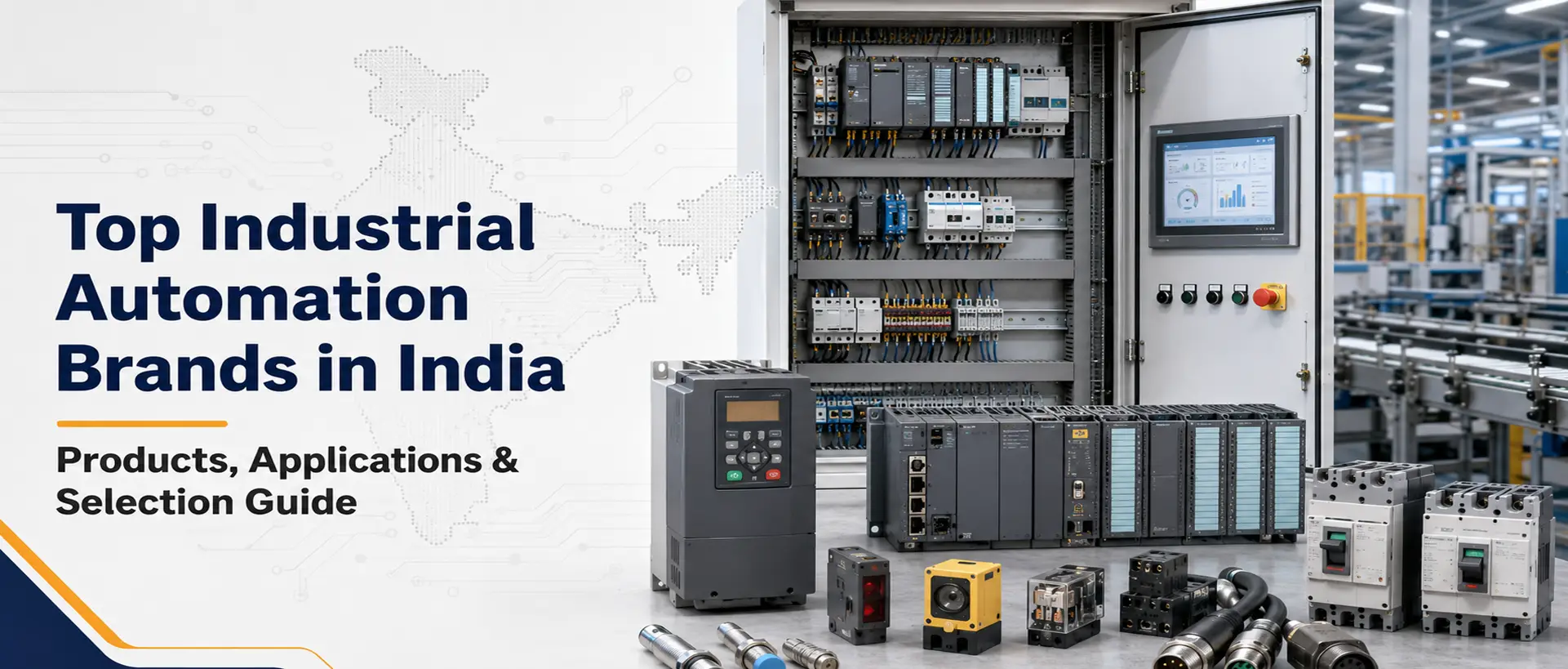
Industrial automation depends on thousands of components working together reliably—from sensors detecting objects on a production line to controllers managing machine sequences, drives regulating motor movement, safety devices protecting operators, and instrumentation monitoring critical process parameters.
Choosing these components is not simply about finding a product with the required specifications. The industrial automation brand behind the product can influence compatibility, reliability, product availability, maintenance requirements, system integration, replacement planning, and long-term operational performance.
India's manufacturing, automotive, pharmaceutical, FMCG, food processing, packaging, warehousing, infrastructure, and process industries use automation products from a wide range of established global manufacturers. Brands such as ABB, Allen-Bradley, Balluff, Banner, Baumer, Festo, Honeywell, IFM, Keyence, Mitsubishi Electric, OMRON, Phoenix Contact, Schneider Electric, SICK, Siemens, Turck, and WAGO support different areas of industrial and factory automation.
However, these manufacturers do not necessarily compete in exactly the same product categories. Some are strongly associated with automation and control systems, while others specialize in sensing, connectivity, machine safety, pneumatics, process measurement, motion control, or related automation technologies.
For procurement teams, machine builders, panel builders, maintenance departments, system integrators, and industrial buyers, understanding these brands according to their technologies and applications makes product selection more systematic.
This guide explains the major industrial automation brands in India, the product categories they support, their common applications, and what industrial buyers should evaluate before selecting or sourcing automation products.
Industrial automation brands manufacture technologies used to automate, control, monitor, connect, measure, protect, and optimize machines and industrial processes.
Industrial automation covers much more than PLCs and machine controllers. A complete automated environment may require:
These technologies generally operate as parts of an interconnected machine or plant system.
For example, a sensor may detect a product entering a machine. A controller can process that signal and determine the next operation. A drive, motor, or pneumatic actuator may then perform the required movement, while safety components monitor whether the operation can continue safely.
This is why industrial buyers should evaluate products not only individually but also according to their relationship with the complete machine, control architecture, and production environment.
Two automation components may appear similar based on their basic function, but that does not automatically make them interchangeable.
Industrial equipment can operate continuously under demanding conditions involving heat, vibration, dust, moisture, electrical interference, repetitive motion, and high production loads.
The selected brand and product series therefore need to match the actual application.
A component failure in an industrial environment can have consequences far beyond the replacement cost of the component.
Failure of a sensor, controller, safety device, drive, connector, or other critical automation component may interrupt production, affect downstream equipment, increase maintenance requirements, or create unplanned downtime.
Product selection should therefore consider operating conditions, expected duty cycle, electrical characteristics, environmental requirements, response characteristics, and technical specifications.
The objective is not simply to choose a popular automation brand. It is to select the correct product from a suitable manufacturer for the actual operating requirement.
Industrial facilities frequently operate equipment from multiple manufacturers.
A production machine might contain sensors from one brand, controllers from another, safety products from another, connectivity products from another, and pneumatic equipment from a different manufacturer.
Compatibility with existing control architecture, electrical ratings, communication protocols, mounting arrangements, connectors, and related equipment should therefore be verified before procurement.
For replacement requirements in particular, buyers should compare complete model information rather than relying only on a general product description.
Automation components can directly influence machine and personnel safety.
Applications involving machine guarding, emergency stopping, automated movement, process monitoring, or potentially hazardous operating conditions require careful technical evaluation.
Products used for safety-related functions should therefore be selected according to the required safety function, machine architecture, specifications, and applicable requirements—not simply because another component looks similar.
Industrial machines can remain operational for many years.
During that lifecycle, plants may require replacement sensors, controllers, switches, connectors, drives, safety components, pneumatic products, or other automation equipment.
Procurement teams should consider whether replacement products, compatible products, accessories, and technical information can be sourced when required.
Availability becomes particularly important for maintenance and breakdown requirements where delays in obtaining a relatively small component can extend machine downtime.
Industrial automation should be viewed as a lifecycle requirement rather than a one-time purchase.
Installation, expansion, troubleshooting, replacement, modernization, and machine upgrades can all create additional component requirements later.
Selecting established product families and sourcing through a knowledgeable industrial automation supplier can simplify these requirements.
BE Electricals provides access to a broad portfolio of industrial automation brands supporting factory automation, machine control, sensing, connectivity, safety, pneumatics, instrumentation, motion, drives, and related industrial technologies.
Instead of viewing every manufacturer as a direct alternative to another, industrial buyers can understand these brands according to the technology categories and applications they support.
Automation and control technologies form the decision-making layer of modern machines and production systems.
Brands associated with different areas of industrial and factory automation include ABB, Allen-Bradley, Carlo Gavazzi, Honeywell, Mitsubishi Electric, OMRON, Schneider Electric, Siemens, Delta Electronics, Fuji Electric, Bosch Rexroth, Crouzet, and IDEC.
Depending on the manufacturer and product family, automation technologies may support:
For OEMs and machine builders, selection usually depends on the architecture of the machine being developed.
For an existing manufacturing plant, compatibility with installed automation equipment can become equally important.
A facility already using a particular control architecture may prefer compatible components where doing so simplifies engineering, integration, maintenance, troubleshooting, and spare-parts management.
Sensors allow an industrial control system to understand what is happening within a machine or production process.
Depending on the sensing technology, they can detect presence, position, distance, movement, identification, machine conditions, and other physical parameters.
Major industrial sensor brands across the automation market include Balluff, Banner, Baumer, IFM, Keyence, Leuze, SICK, Turck, and Datalogic.
Different manufacturers support different sensing and detection requirements, which may include proximity sensing, photoelectric detection, machine vision, identification, measurement, and condition monitoring.
Manufacturing: Detecting components, verifying position, monitoring machines, and providing feedback for automated assembly.
Material Handling: Tracking products and detecting objects across conveyor, transfer, and sorting systems.
Packaging: Product detection, positioning, counting, inspection, and packaging-line automation.
Automotive Production: Component detection, assembly verification, positioning, and automated manufacturing.
Warehousing: Detection, identification, conveying, sorting, and automated material movement.
Machine Building: Providing the feedback required for machine sequences and automated operations.
Choosing an industrial sensor should therefore begin with the sensing requirement rather than the brand alone.
Detection distance, target material, mounting space, response characteristics, output configuration, operating environment, and connection method can all influence selection.
Reliable automation depends on effective communication and connectivity between individual components.
Brands associated with industrial connectivity and automation interfaces include Connectwell, HARTING, Phoenix Contact, WAGO, Weidmuller, LAPP, and Belden.
These products may look like relatively small parts of an automation system, but poor connectivity can cause intermittent faults, communication problems, difficult maintenance, and unnecessary downtime.
Engineers should therefore evaluate electrical ratings, conductor requirements, connection methods, environmental exposure, communication requirements, installation space, and maintenance accessibility.
Automation can improve productivity, but automated machinery must also incorporate appropriate safety systems.
Brands such as Pilz, Pizzato, and Schmersal serve different areas of machine and industrial safety.
Depending on the application, safety requirements may involve machine access monitoring, safety switching, personnel protection, and related machine-safety functions.
Production equipment may contain moving mechanisms, automated systems, electrical equipment, and areas where operators or maintenance personnel interact with machinery.
Safety components help engineers implement appropriate safeguards according to the machine design and required safety functions.
A safety component should therefore never be selected solely because another product looks similar. The required safety function, electrical characteristics, installation method, machine architecture, and applicable requirements should all be evaluated.
Not every industrial movement is driven directly by an electric motor.
Pneumatic and motion systems are widely used for gripping, pushing, lifting, positioning, clamping, transferring, and other repetitive machine movements.
Brands such as Festo, Parker Hannifin, and Bosch Rexroth are associated with different pneumatic, motion, and industrial-control requirements.
These technologies can be found in assembly equipment, packaging machinery, production automation, material handling, machine tools, and special-purpose machines.
Selection may depend on operating pressure, required force, movement, speed, available space, cycle frequency, environmental conditions, and compatibility with the wider automation system.
A plant cannot effectively control a variable that it cannot reliably measure.
Industrial instrumentation provides the information required to monitor processes, test equipment, verify operating conditions, and make control decisions.
Brands such as Endress+Hauser, Rosemount, Fluke, and HBM serve different areas of industrial instrumentation, measurement, testing, and monitoring.
Depending on the application, measurement requirements can relate to process variables, electrical parameters, equipment condition, force, load, and other operational data.
These technologies are particularly important in process industries, manufacturing plants, utilities, maintenance operations, testing environments, and quality-control applications.
Automation systems ultimately need to create physical movement or regulate industrial processes.
Brands such as ABB, Danfoss, Bonfiglioli, Siemens, Schneider Electric, Mitsubishi Electric, Fuji Electric, and Bosch Rexroth support different areas related to drives, motion, motor control, and industrial automation.
Depending on the product family and application, these technologies can support:
Correct sizing is essential because selecting a product only by category without considering load, duty, operating conditions, speed, torque, or system architecture can result in unsuitable equipment.
The value of industrial automation becomes clearer when technologies are viewed according to actual applications rather than individual products.
A modern production line can combine controllers, sensors, safety equipment, drives, industrial communication, pneumatic components, connectivity products, and measurement technologies.
These systems work together to reduce repetitive manual intervention, coordinate machine operations, provide process feedback, and create more controlled production processes.
OEMs frequently require components from multiple industrial automation brands when designing machinery.
Selection depends on machine architecture, technical specifications, customer requirements, available installation space, control philosophy, communication requirements, and expected operating environment.
The objective is not necessarily to use every product from one manufacturer. It is to create a compatible, reliable, and maintainable automation system around the machine's actual requirements.
Control panels bring multiple automation components together within an organized system.
Depending on the design, a panel may contain controllers, switching and control devices, terminals, interfaces, communication components, drives, and related automation products.
Product selection should therefore account for the overall panel architecture rather than treating each component independently.
Process industries require continuous monitoring and control of operating conditions.
Instrumentation, controllers, drives, sensors, and related automation equipment can work together to maintain required process conditions and provide operational information.
Conveyors, sorting systems, automated warehouses, and material-transfer equipment rely on sensing, control, drives, safety devices, and communication technologies.
Sensors may detect products, controllers can process the information, drives can regulate movement, and safety components can support safe interaction with the system.
Packaging machinery frequently operates at high cycle rates.
Sensors, machine controls, motion components, safety devices, and identification technologies help coordinate detection, positioning, inspection, movement, and other packaging-line operations.
Automation procurement is not limited to new machines and projects.
Maintenance teams regularly require replacement sensors, switches, automation components, connectors, measuring instruments, safety products, and related industrial equipment.
Quick identification of the correct brand, model, and specification can help reduce unnecessary downtime.
Automation is no longer limited to highly automated automotive plants.
Industrial automation technologies are used across a broad range of sectors.
Factories use automation for production control, assembly, inspection, material handling, machine monitoring, and process coordination.
Automotive manufacturing uses extensive sensing, control, identification, machine safety, motion, and production automation.
Automated production, processing, packaging, conveying, and monitoring technologies help food and beverage facilities maintain controlled operations.
Pharmaceutical manufacturing uses automation and instrumentation for controlled production, packaging, monitoring, and process management.
FMCG
High-volume FMCG production requires dependable packaging, conveying, detection, control, and production-line automation.
Packaging machinery relies heavily on sensors, automation controllers, motion systems, safety devices, identification technologies, and industrial communication.
Automated conveying, sorting, identification, storage, and material movement require reliable industrial automation components.
Process facilities depend on instrumentation, monitoring, automation, drives, and control systems to manage operating variables.
Machine builders integrate components from multiple automation brands to create complete machines and systems for their customers.
Automation controls, instrumentation, monitoring technologies, drives, and related equipment can support water systems, building services, infrastructure, and utility applications.
There is no single industrial automation brand that is automatically right for every application.
A more reliable selection process begins with the technical requirement.
Start by identifying exactly what the component must do.
For a sensor, the requirement could be detecting a particular object at a defined distance.
For a drive, it may involve regulating the speed of a motor.
For instrumentation, it may involve measuring a particular process variable.
Clear application requirements prevent buyers from comparing products designed for different functions.
Compare the specifications that directly affect the application.
Depending on the product, these may include:
The most appropriate product is the one whose specifications correctly match the application—not necessarily the product with the longest feature list.
Check whether the component can integrate with the existing machine or automation system.
For replacement procurement, compare complete model information wherever possible rather than relying on a general product name or appearance.
A component installed inside a protected control cabinet has different requirements from one installed near a washdown area, dusty production process, outdoor machine, or high-vibration environment.
Environmental conditions should therefore be evaluated before procurement.
5. Evaluate Safety Requirements
Where a product performs a safety-related function, its suitability should be assessed according to the required machine-safety architecture and application specifications.
Safety products should not be substituted solely on the basis of apparent physical similarity.
A technically suitable automation component has limited practical value if it cannot be obtained within the required project or maintenance schedule.
Availability is particularly important for breakdown and plant-maintenance requirements.
Think beyond initial installation.
Consider whether the model, accessories, compatible products, and technical information can be sourced when future maintenance is required.
Industrial procurement frequently involves precise model numbers and specifications.
Working with an experienced industrial automation products supplier can help buyers identify required products, consolidate multi-brand requirements, and make the procurement process more manageable.
Should a factory standardize everything around one automation brand?
In some cases, standardization can simplify engineering, inventory management, employee training, troubleshooting, and maintenance.
However, modern industrial systems frequently require technologies from different specialist manufacturers.
A production machine could use:
This makes multi-brand industrial automation sourcing particularly relevant for OEMs, factories, system integrators, panel builders, project teams, and maintenance departments.
Instead of managing separate sourcing channels for every requirement, buyers may consolidate multiple product categories through a multi-brand industrial automation supplier where appropriate.
The objective should not be to use the maximum number of brands. It should be to select suitable products while keeping compatibility, procurement, availability, maintenance, and lifecycle management practical.
Industrial automation components often operate continuously and can directly influence production reliability.
This makes product authenticity and correct sourcing important.
Genuine products provide greater confidence that the model, technical specifications, manufacturing origin, and expected performance correspond with the product selected by the engineer or procurement team.
Reliable sourcing can also reduce risks associated with incorrect model substitutions or products whose specifications cannot be properly verified.
For industrial buyers, genuine sourcing matters in several areas:
Reliability: The component needs to perform according to the intended specification.
Compatibility: Incorrect or unidentified substitutes can create integration problems.
Safety: Safety-related automation components need to match the intended design requirements.
Traceability: Clear brand and model information simplifies procurement records and future replacement.
Maintenance: Correct product identification makes future MRO procurement easier.
Lifecycle Management: Reliable sourcing helps facilities maintain consistency when replacing installed automation components.
Selecting the right industrial automation distributor or supplier can be almost as important as identifying the required brand.
Industrial buyers should evaluate several factors.
A supplier with access to multiple industrial automation brands can help consolidate requirements across control, sensing, safety, connectivity, instrumentation, pneumatics, drives, and related technologies.
Industrial enquiries frequently arrive as exact model numbers, old product references, photographs, nameplate details, or partial technical specifications.
A supplier familiar with industrial automation products can make product identification and quotation more efficient.
Buyers should prioritize reliable sourcing, particularly for automation components used in critical industrial applications.
Correct brand, model, and specification identification should remain central to the procurement process.
OEMs, project companies, system integrators, panel builders, and manufacturing plants may require multiple quantities or products from several manufacturers under one procurement requirement.
A supplier should be capable of handling these requirements systematically.
A supplier does not replace the design engineer, but familiarity with industrial automation product categories can improve communication during identification, quotation, and procurement.
For businesses operating plants, projects, or maintenance teams across multiple locations, the ability to source industrial automation products across India can simplify procurement.
Industrial Automation Products from BE Electricals
BE Electricals is an industrial automation product supplier serving industrial buyers across India.
Established in 1996, the company works with a broad portfolio of established manufacturers covering factory automation, sensors, control technologies, industrial connectivity, machine safety, pneumatics, instrumentation, measurement, drives, motion, and related industrial technologies.
The brand portfolio includes names such as ABB, Allen-Bradley, Balluff, Banner, Baumer, Carlo Gavazzi, Eaton, Festo, Honeywell, IFM, Keyence, Mitsubishi Electric, OMRON, Phoenix Contact, Schneider Electric, SICK, Siemens, Turck, WAGO, Fluke, Danfoss, Delta Electronics, Fuji Electric, Parker Hannifin, Rosemount, and other industrial manufacturers.
For buyers, this multi-brand approach can be particularly useful when a requirement includes components from different manufacturers rather than products belonging to a single product family.
Whether the requirement involves factory automation, machine building, control panels, MRO, process instrumentation, sensing, machine safety, industrial connectivity, motion, or drives, procurement should begin with the correct brand, model, specification, quantity, and application requirement.
Industrial automation brands manufacture technologies used to automate, control, monitor, measure, connect, and optimize industrial machines and processes. Their portfolios may include controllers, sensors, drives, safety products, connectivity solutions, instrumentation, pneumatics, and other automation technologies.
The industrial automation market includes brands such as ABB, Allen-Bradley, Balluff, Banner, Baumer, Honeywell, IFM, Keyence, Mitsubishi Electric, OMRON, Schneider Electric, SICK, Siemens, Turck, WAGO, and many others. The appropriate manufacturer depends on the technology and application required.
A wide range of established global automation brands are available in India across factory automation, sensors, machine safety, pneumatics, instrumentation, industrial connectivity, drives, and control technologies. Availability can vary according to the exact manufacturer, product series, and model.
Industrial automation products can include PLCs, controllers, sensors, drives, switches, safety devices, industrial communication products, connectors, instrumentation, pneumatic components, operator interfaces, machine-vision systems, and related control technologies.
Brands associated with industrial sensing and detection include Balluff, Banner, Baumer, IFM, Keyence, Leuze, SICK, Turck, and others. Selection should be based on sensing technology, technical specifications, operating environment, and application requirements.
Brands such as ABB, Allen-Bradley, Mitsubishi Electric, OMRON, Schneider Electric, Siemens, Delta Electronics, Fuji Electric, Honeywell, and others support different areas of factory and machine automation. The suitable choice depends on the required product category and existing system architecture.
Start by defining the required function and technical specifications. Then evaluate compatibility, operating environment, communication requirements, availability, safety requirements, maintenance needs, and lifecycle considerations before selecting the manufacturer and model.
Yes. Industrial machines commonly integrate components from multiple manufacturers. However, technical compatibility, interfaces, communication protocols, electrical characteristics, and application requirements should be verified before integration.
Industrial buyers can source products through industrial automation suppliers and distributors such as BE Electricals. Providing the exact brand, model number, quantity, specifications, and application details wherever possible can make product identification and quotation more efficient.
Automation components can affect machine reliability, compatibility, safety, and production continuity. Reliable sourcing helps buyers obtain correctly identified products and reduces risks associated with unsuitable or unverifiable components.
Yes. A multi-brand industrial automation supplier can source requirements across several manufacturers, helping OEMs, factories, system integrators, panel builders, project teams, and maintenance departments consolidate procurement.
Industrial automation procurement is not about identifying one universally "best" automation brand.
It is about selecting the right technology, specification, manufacturer, and product for the actual application.
A sensor that performs well in one machine may not suit another operating environment. A controller suitable for a standalone machine may not match an existing plant architecture. The same principle applies to safety products, industrial connectors, instrumentation, pneumatics, drives, and other automation technologies.
Successful industrial sourcing therefore begins with application clarity, technical verification, system compatibility, and dependable product sourcing.
BE Electricals supports industrial buyers with access to a broad portfolio of industrial automation brands for factory automation, machine building, control panels, MRO, sensing, machine safety, instrumentation, industrial connectivity, motion, drives, and related requirements. Explore the BE Electricals brand portfolio or share your required brand, model number, specifications, quantity, and application with the team to identify suitable products and request a quotation. Learn more about BE Electricals